
A LARGE MANUFACTURER
2026-03-01
Project Background
At present, the manufacturing industry is accelerating its transformation towards intelligence. A large manufacturing enterprise is actively promoting the construction of an intelligent factory, with the core goal of achieving automated and refined management throughout the entire production process. During the production and operation process, the factory has a large number of periodic tasks of different frequencies, covering multiple links such as production plan execution, material scheduling, inventory management, and data collection and analysis, and there are complex dependencies:
High-frequency tasks (such as hourly and two-hour data collection) need to drive low-frequency tasks (such as daily/shift production reports).
Low-frequency tasks (such as daily material inventory checks) will in turn trigger high-frequency inventory warnings and replenishment scheduling.
Previously, relying on manual triggering and distributed scheduling, it was impossible to precisely handle the dependencies between high and low frequency tasks, often resulting in problems such as task delays, execution errors, and inconsistent data, which seriously affected the operational efficiency of smart factories and made it difficult to meet the control requirements of intelligent production.
To this end, the enterprise introduced WLOADCTL, relying on its complex timing and frequency scheduling as well as dependency orchestration capabilities, to achieve the automated management of periodic tasks in the production process.
Technical Solution
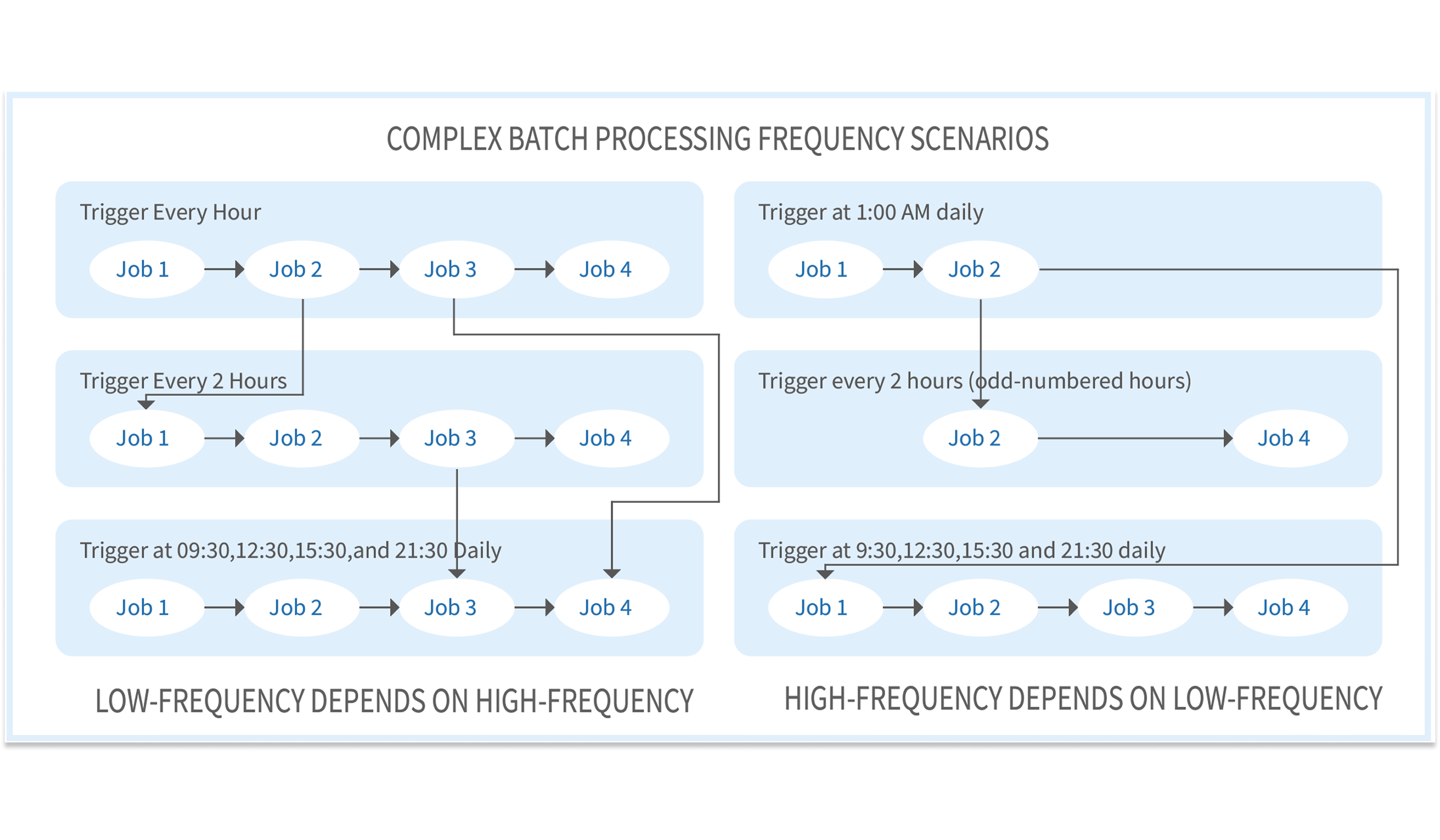
During the construction of the smart factory, this manufacturing enterprise has achieved the automated scheduling of periodic tasks with different frequencies and complex dependencies based on WLOADCTL. The core implementation contents include:
Centralized management and automatic triggering of multi-frequency tasks
Unify the scheduling of tasks with different execution frequencies: including high-frequency data collection every hour/every two hours, shift production tasks at 9:30, 12:30, 15:30 and 21:30 every day, and the end-of-day settlement task at 1 a.m. every day, etc., to achieve timed triggering in all scenarios.
Precise scheduling of dependencies between high and low frequency tasks
Adapt to two typical dependency scenarios:
Low-frequency tasks rely on high-frequency tasks: for instance, the end-of-day report task must wait until the hourly data collection task is completed before execution.
High-frequency tasks rely on low-frequency tasks: for instance, the inventory scheduling task every two hours must be based on the daily material inventory results as a prerequisite.
Implement dependency verification between tasks and automatic triggering to avoid data discontinuity.
Unified orchestration of periodic tasks across business systems
End-to-end orchestration of cross-system tasks such as production planning execution, material scheduling, inventory management, and warehousing logistics is carried out to form a coherent automated workflow, ensuring that upstream and downstream tasks are executed in an orderly manner according to the production rhythm.
The automated closed loop of the production data link
Realize the full-process automation of production data collection, analysis, report generation and push. High-frequency collected data is automatically cleaned and summarized to drive shift production and daily report tasks. Finally, the analysis results are pushed to the production management department to support decision-making.
Application effect
Efficient implementation of complex scheduling scenarios: The automated scheduling of periodic tasks with different frequencies and dependencies has been successfully achieved, solving the coordination problem between high and low frequency tasks and making the production rhythm more stable.
Human intervention has been significantly reduced: It has bid farewell to the mode of manual triggering, dependency verification and manual scheduling, effectively avoiding the errors and delays caused by manual scheduling, and reducing the manual management costs in the production process.
Data consistency has been significantly improved: By relying on scheduling, the correct sequence of data collection, processing, and report generation is ensured, avoiding data discontinuity and inconsistency issues, and providing reliable data support for production decisions.
The operational efficiency of smart factories has been comprehensively enhanced: The full-process automated dispatching ensures efficient collaboration among production, warehousing and logistics links, helping enterprises achieve intelligent control of the entire production process and further consolidating the achievements of intelligent factory construction.